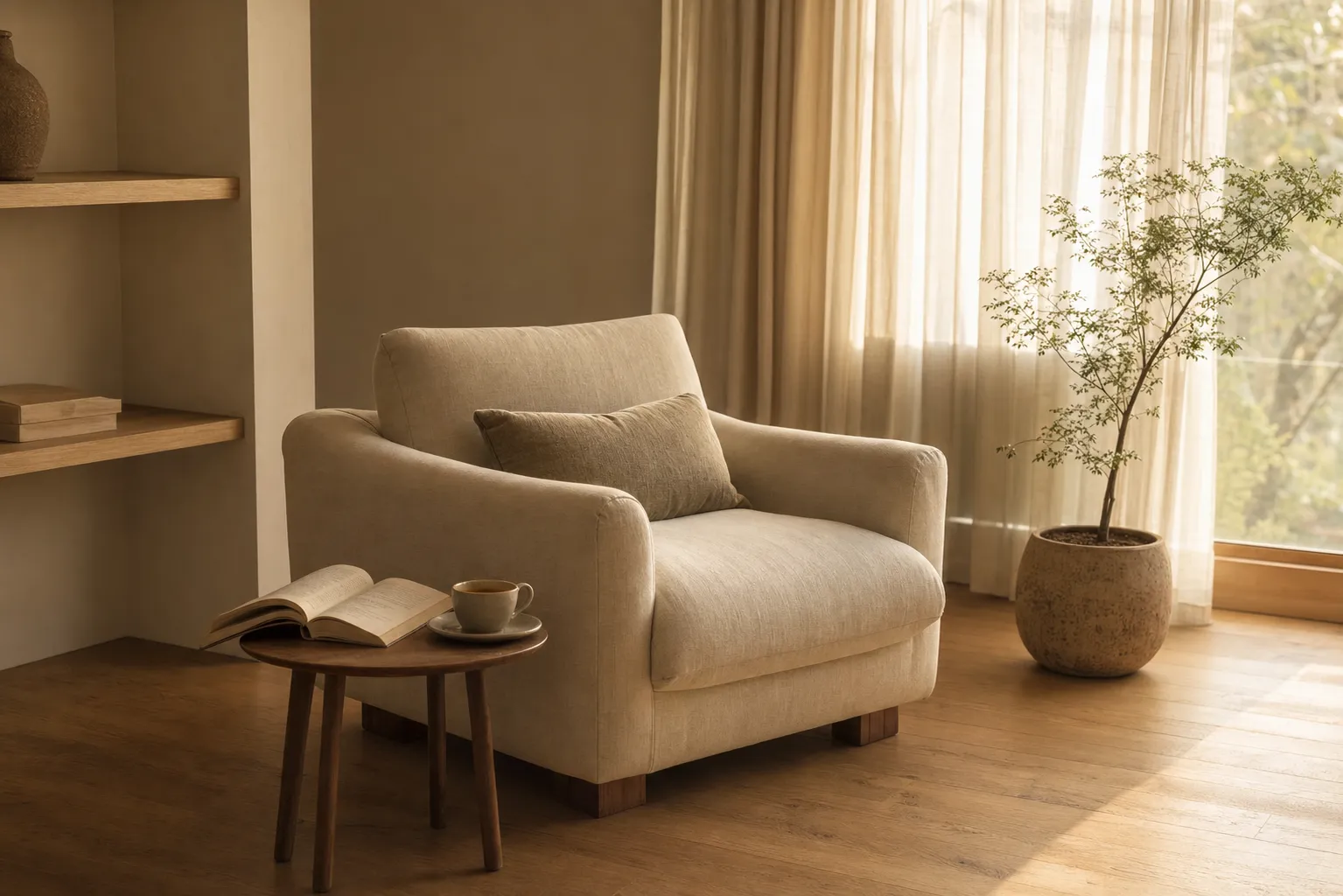
I ask nearly every new client some version of the same question in our first few sessions: "What does your bedroom actually look like right now?" It usually gets a surprised laugh — people expect me to ask about their childhood, their relationships, their inner monologue, not their curtains. But after 25+ years of practice, I've come to believe the room a person lives in is never neutral. It is either quietly working with their nervous system, or quietly working against it.
Your nervous system is always reading the room
This isn't a metaphor — it's measurable. Research on biophilic indoor environments has found that spaces incorporating natural materials, plants, and daylight measurably speed recovery from psychological stress and anxiety compared to conventional interiors (PubMed). Your body is scanning a room for safety cues long before your conscious mind has an opinion about the décor. A space that feels chaotic, cluttered, or exposed keeps a low hum of vigilance running in the background — and that hum has a cost, session after session, day after day.
Light doesn't just help you see — it tells your brain when to sleep
Few environmental factors affect mental health as directly as light exposure. Circadian lighting research shows that the timing, intensity, and color temperature of the light we're exposed to shapes our circadian rhythms, sleep quality, and mood in ways most people never consciously register (PubMed). A home lit the same harsh, blue-toned way at 9pm as it is at noon is, in effect, sending your brain the wrong message at exactly the moment you need to be winding down. I see this constantly in clients struggling with sleep, irritability, or low mood who have never once considered that their lighting might be part of the problem.
The air in a room shapes how clearly you think
Harvard's landmark COGfx studies found that improved indoor air quality and ventilation measurably raised cognitive function scores — including in domains like information usage, strategy, and focused activity level (Harvard T.H. Chan School of Public Health). Follow-up reporting on the research noted the same pattern in real office environments, where better air quality was tied to sharper thinking and higher productivity (Harvard T.H. Chan School of Public Health). Clients doing the hardest emotional work of their lives need every bit of cognitive clarity they can get. A stuffy, poorly ventilated home is quietly taxing the same mental resources therapy asks you to bring to the table.
Quiet is a psychological need, not a luxury
The World Health Organization's Environmental Noise Guidelines are explicit that chronic exposure to environmental noise is linked to measurable harm — including sleep disturbance and adverse mental health outcomes — even at levels many people consider "background noise" (PMC). I've had clients spend months in individual work managing anxiety, only for us to eventually trace a piece of it back to a bedroom that backs directly onto a busy street. The nervous system doesn't fully distinguish between "manageable background noise" and "the ongoing sound of intrusion" — it just keeps registering low-level threat.
Six Pillars of a Psychologically Healthy Home
None of this is about needing a perfect house, and it is absolutely not about spending your way into wellness. But if you're doing real inner work, it's worth understanding what a home that actually supports a nervous system looks like. I think about it in six areas — the same six areas that ÖND | Life’s Breath™, the design philosophy I partner with, treats as core infrastructure rather than décor:
Light That Follows the Day
Bright, natural light in the morning; warm, dim light in the evening — matching your body's own rhythm instead of fighting it.
Air You Can Actually Breathe
Real ventilation and filtration, not just an open window — the difference between a foggy head and a clear one.
Materials That Don't Fight Your Body
Natural fibers and finishes over synthetic ones, wherever it's realistically possible — less to quietly react against.
Water You Trust
Clean water is a basic safety cue your body registers, whether or not you consciously think about it.
A Nervous System That Can Power Down
A sleep space that feels genuinely shielded and safe, without constant low-level stimulation.
Real Quiet
Sound insulation and thoughtful acoustics — because your nervous system never fully relaxes in a noisy room.
Bringing this into the room with me
My own framework, the Six Pillars — Presence, Connection, Embodiment, Emotional Freedom, Resilience, and Purpose — is about the psychological work: how you relate to yourself, to others, to your history. But I've stopped pretending that work happens in a vacuum. It happens in a specific room, at a specific hour, in specific light, with specific sounds coming through the walls. That's exactly why I partner with ÖND | Life’s Breath™ — because the psychological work you do with me deserves a home that's actually built to hold it.
You can't out-therapy a bedroom that never lets you rest, and you can't fully think your way past a home that fogs your head every day. If any part of this resonates, it might be worth taking an honest look at the room you're reading this in right now — and if you'd like support with the inner work alongside it, I'd welcome the chance to work together. Read more about individual therapy or explore the ÖND partnership in full.